Generic
Exostosis Ear: Causes, Symptoms, and Everything You Need to Know
By Team Hearzap | March 23, 2026
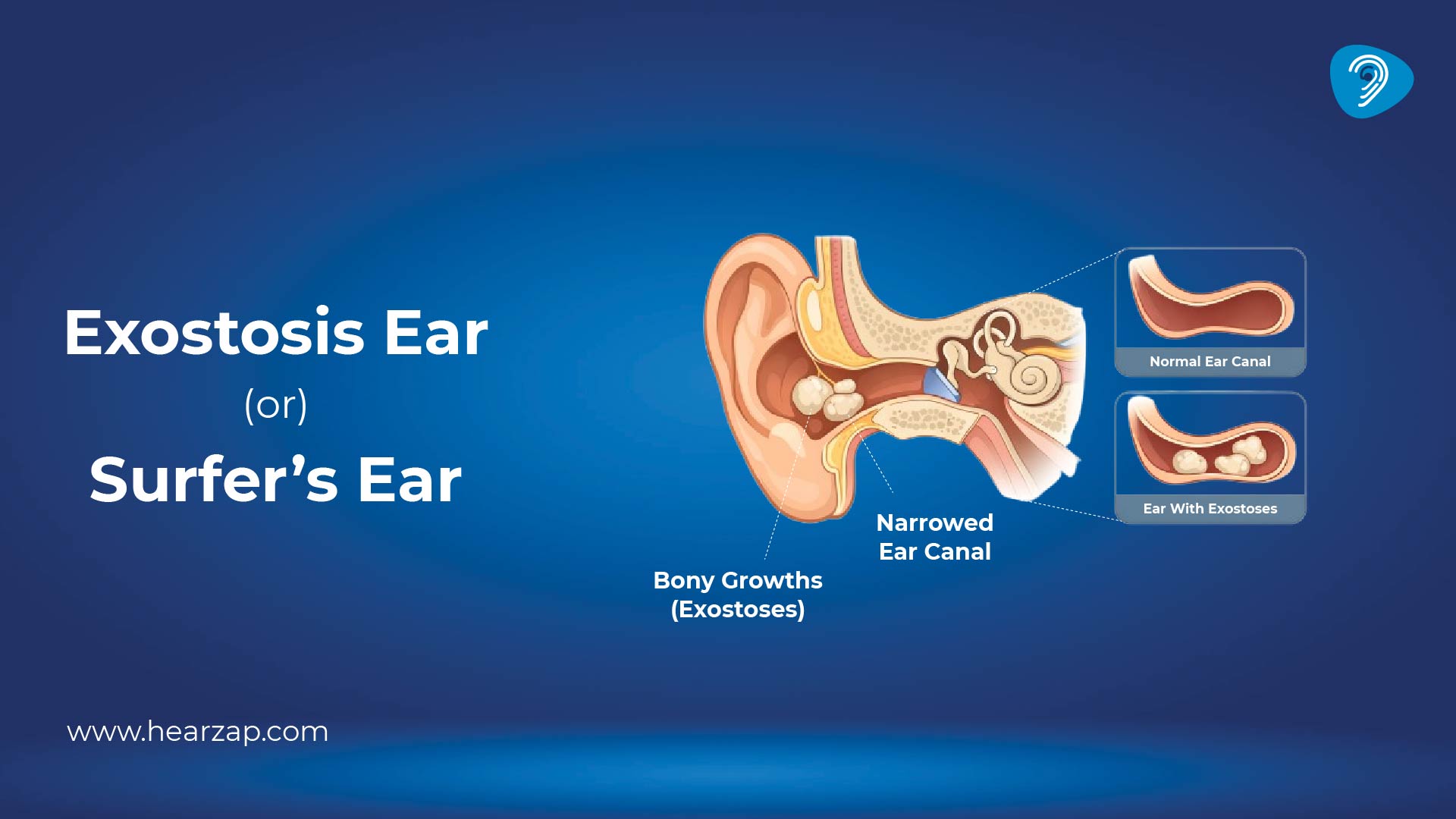
If you've ever spent a lot of time swimming in cold water you may have come across a condition that's quietly common among water sports enthusiasts. Exostosis ear is a condition where bony growths develop inside the ear canal, and while it sounds alarming, understanding it can make all the difference in catching it early and managing it well.
What Is Ear Exostosis?
Your ear canal is a narrow passage, roughly 2.5 centimetres long, that runs from the outer ear to the eardrum. The walls of this canal are lined partly with soft tissue and partly with bone. In a healthy ear, those bony walls are smooth and unremarkable.
In exostosis, the bone begins to grow abnormally inward — not outward like a spike, but as broad, rounded lumps that gradually narrow the canal from the inside. Over time, these growths can partially or even completely block the ear canal, causing a range of hearing and ear health problems.
The condition develops slowly, often over many years, which means many people don't notice anything is wrong until the blockage becomes significant.
Exostosis Surfer's Ear: Why Cold Water Is the Culprit
The most well-known form of this condition goes by a vivid nickname — exostosis surfer's ear. This name exists for good reason. The condition is dramatically more common in people who regularly expose their ears to cold water and wind like surfers, swimmers, divers, kayakers, and even sailors.
When cold water or cold air repeatedly enters the ear canal, it triggers a stress response in the underlying bone. The body, interpreting this repeated cold exposure as a threat, attempts to protect the eardrum by laying down new bone tissue. The bone essentially tries to close off the canal to keep the cold out. It's a well-intentioned but ultimately counterproductive response.
Studies have found that people who surf or swim in cold water for more than ten hours per week over several years are at significantly higher risk. The colder the water, the greater the risk. This is why the condition is far more prevalent among surfers in places like the UK, Ireland, Australia's southern coast, California, and South Africa than in warm tropical waters.
Importantly, you don't have to be a professional surfer to develop this. Recreational swimmers, cold-water dippers, and anyone who regularly gets cold water in their ears over many years can develop it — it just takes longer.
Exostosis Ear Canal: What's Actually Happening Inside
Within the exostosis ear canal, the bony growths tend to appear near the eardrum end of the canal, where the bone is closest to the surface. They typically develop on multiple walls simultaneously, which is what gives them that characteristic narrowing effect rather than a single protruding lump.
As the canal narrows, two main problems emerge. First, water and debris that enter the ear can no longer drain out efficiently — they get trapped behind the growths. This creates a warm, moist environment that is highly favourable for bacterial and fungal infections. People with this condition often suffer from recurrent outer ear infections, sometimes called swimmer's ear, that keep coming back despite treatment. Second, as the growths enlarge, they begin to muffle sound, leading to a sensation of blocked ears and eventually measurable hearing loss.
Exostosis Ear vs Osteoma: An Important Distinction
Here's where things get a little more technical, but it's worth understanding because these two conditions are frequently confused — even in medical settings.
Exostosis ear vs osteoma is a comparison that comes up often, and the differences matter for both diagnosis and treatment.
Exostosis involves multiple smooth, broad-based bony growths that develop along several walls of the ear canal. They are almost always linked to repeated cold water exposure, they tend to be bilateral (affecting both ears), and they grow very slowly over years or decades.
An osteoma, by contrast, is a single, discrete bony lump, usually attached to the canal wall by a narrow stalk (called a pedunculated base). Osteomas are not caused by environmental exposure — they tend to occur spontaneously or due to genetic factors. They are typically unilateral (affecting only one ear), and while they are benign like exostoses, they are a distinct pathological entity.
In simple terms: exostosis looks like multiple rounded hills gradually filling up the canal; an osteoma looks more like a single pea on a stalk. A doctor examining the ear with an otoscope, or in more detail with a CT scan, can usually distinguish between the two with reasonable confidence.
The distinction matters because treatment decisions, particularly around surgery, may differ depending on which condition is present.
Symptoms to Watch For
Because the condition develops so gradually, many people dismiss the early warning signs as a simple blocked ear or recurring infections. Key symptoms to be aware of include:
- Muffled or reduced hearing — particularly after water exposure, when trapped water amplifies the blockage effect.
- A persistent feeling of fullness in the ear, as though it needs to pop.
- Recurrent ear infections that don't seem to resolve fully or keep returning despite appropriate treatment.
- Water getting stuck in the ear canal after swimming, sometimes for hours or days.
- Tinnitus (ringing or buzzing sounds) in more advanced cases.
In mild cases, these symptoms may only appear after swimming. As the growths enlarge, they can become noticeable even in daily life.
Exostosis of External Ear Canal: Diagnosis and Treatment
Diagnosing exostosis of external ear canal is usually straightforward for a trained ENT specialist. A simple examination with an otoscope — the small tool used to look inside the ear — can reveal the characteristic bony narrowing. A CT scan may be ordered to better assess the size, number, and precise location of the growths before any surgical planning.
When treatment is needed:
Mild exostosis with no significant symptoms generally requires no treatment — just monitoring and sensible prevention measures. For anyone still actively swimming or surfing, wearing well-fitted custom ear plugs and a neoprene surf cap that covers the ears are strongly recommended to slow further growth.
When the narrowing becomes significant — causing persistent infections, trapped water, or meaningful hearing loss — surgery is the main treatment option. The procedure is called a canaloplasty, where a surgeon carefully drills away the bony growths to restore a normal canal diameter. The surgery is performed under general anaesthesia and has a very high success rate. Recovery typically involves keeping the ear dry for several weeks while the canal heals.
Surgery is not recommended lightly, since the ear canal is a delicate structure close to the eardrum and facial nerve. An experienced skull-base or ear surgeon is the appropriate person to perform this procedure.
Prevention: The Simplest Fix
The encouraging thing about this condition is that it is largely preventable — or at least its progression can be significantly slowed. If you regularly swim, surf, or spend time in cold water:
Wear custom-moulded ear plugs designed for water use. Off-the-shelf foam plugs are better than nothing but don't seal as effectively.
Use a neoprene hood or surf cap that covers the ears, particularly in water below 15°C.
Dry your ears gently and thoroughly after water exposure. A warm — never hot — hair dryer held at a distance can help evaporate trapped moisture.
If you've already been diagnosed with mild exostosis, protection becomes even more critical to prevent further bony growth.
The Bottom Line
Exostosis ear is one of those conditions that sneaks up on people over years of doing something they love. It's not dangerous in the way that serious illnesses are, but left unaddressed, it can lead to persistent infections, trapped water, and gradual hearing loss that significantly affects daily life. The good news is that it's diagnosable, treatable, and — most importantly — largely preventable with the right ear protection. If you're a regular cold-water swimmer or surfer and you've been noticing any of the symptoms described here, it's well worth getting your ears checked.
FAQs:
What is exostosis in the ear?
A bony growth in the ear canal, often caused by repeated exposure to cold water or wind.
How do you treat ear exostosis?
Mild cases need monitoring, while severe blockage may require surgical removal
Should exostosis be removed?
It is only removed if it causes symptoms like hearing loss, infections, or blockage.
What is another name for exostosis?
It is commonly called “surfer’s ear.”

Contact us
We are here for all your hearing needs, from hearing tests to hearing aids. Fill out the form below, and we will give you a call soon.
Recent Blogs
By None | March 18, 2026
By None | March 16, 2026
By None | March 13, 2026
By None | March 12, 2026
By None | March 11, 2026