HEARING TEST
Dichotic listening test
By Dattatreya M | Aug. 14, 2026
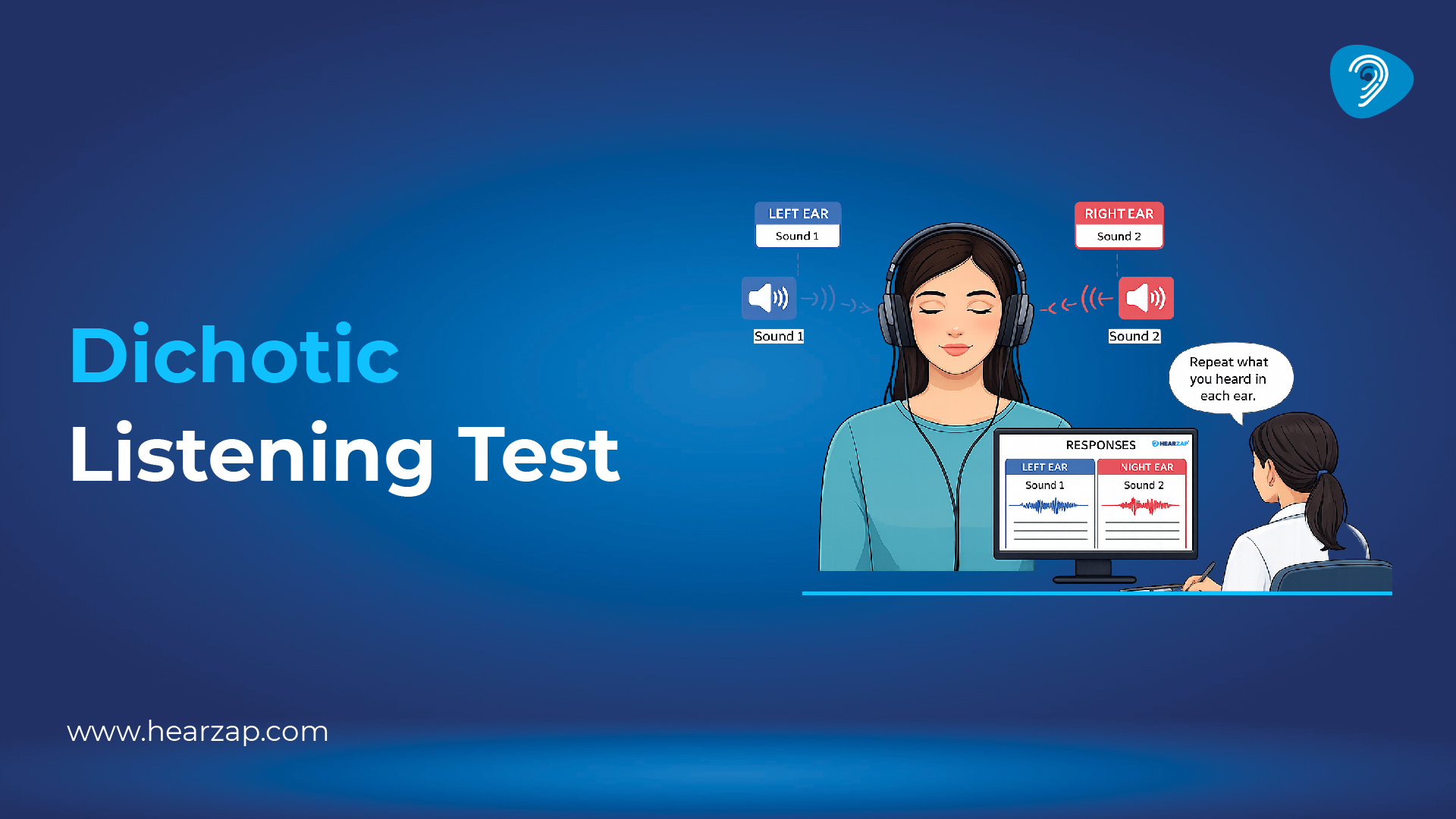
Hearing isn't just about picking up sound. The brain also has to sort through everything coming in, decide what matters, and make sense of it all at once, particularly when there's noise or chaos around you. Audiologists and researchers have leaned on one method for decades to study exactly this: the dichotic listening test.
What Is Dichotic Listening?
Two different sounds, usually words, syllables or digits, get played into each ear at the same time through headphones. One ear hears one thing, the other ear hears something completely different, and the listener then has to say what they heard. Sometimes that means reporting both sounds, sometimes just what came through one ear, depending on how the test is set up.
What makes this useful is what it reveals about the brain itself, specifically how it deals with two competing sounds and how the left and right hemispheres split the job of processing language and sound. The concept isn't new either. It goes back to the early 1950s, though it was Doreen Kimura's research in the 1960s that really put it on the map. She found something interesting: people tend to get sounds right more often when they come through the right ear rather than the left. That's what's now called the right ear advantage, and it comes down to the left hemisphere's job of handling language.
So what does a dichotic listening test actually tell us? Put simply, it shows how capable someone's brain is at handling two sounds competing for attention at the same time, and that connects straight back to attention span, memory and how the brain processes sound overall.
The Underlying Cause of the Right Ear Advantage
This isn't some random quirk. It's down to how the wiring in the brain actually works.
- Sound picked up by the right ear has a more direct path to the left hemisphere, the side that usually does the heavy lifting for language.
- Sound from the left ear also ends up in the left hemisphere, but only after crossing over from the right hemisphere first, which adds a small delay and can cause some information to get lost along the way.
- That extra step is often why left ear responses come out slightly less accurate than right ear responses during a standard test.
This pattern shows up in most right-handed people and is considered typical. Left-handed individuals, or people with a different brain organisation, sometimes show a left ear advantage instead, or no real difference between the two ears at all.
Professionals Who Use This Test
A few different fields rely on dichotic listening, each for their own reasons.
- Audiologists use it as part of a bigger evaluation for auditory processing disorder. It helps them check binaural integration, meaning how well the brain combines input from both ears, and binaural separation, meaning how well someone can focus on one ear while tuning out the other.
- Neuropsychologists use it to figure out which hemisphere is dominant for language, something that matters before certain neurological or surgical procedures.
- Researchers still turn to it when studying attention, memory, and how things like ADHD, learning disabilities or early sensory deprivation shape auditory processing over time.
- With children, the test can flag delays in auditory development, particularly for kids who struggle to follow instructions in a noisy classroom or who have had repeated ear infections early on.
How the Test Works
A typical session usually goes something like this:
- The person wears headphones connected to calibrated equipment, so both ears get sound at an equal, appropriate volume.
- Pairs of stimuli, such as digits, consonant-vowel syllables or short words, play into each ear at the exact same moment.
- Depending on the version being used, the person either repeats everything they heard from both ears (free recall) or focuses on just one ear while ignoring the other (directed attention).
- Trials usually get repeated a few times over, just to be sure the results actually hold up and aren't down to someone simply losing focus for a moment.
Some versions use spoken sounds, while others go with non-speech options like tones, which work better when testing younger children or anyone with limited language ability.
Scoring of Dichotic Listening Tests
When it comes to scoring, there are two main ways to look at the results, and they don't tell you the same thing.
- Single correct score: counts how many items were correctly identified from either ear on its own, regardless of what happened with the other ear.
- Double correct score: counts only the trials where both ears were identified correctly at the same time.
The double correct score matters because it reflects binaural integration rather than just how one ear performed in isolation. Research backs this up too. Both single and double correct scores tend to stay fairly steady when the same person takes the test more than once, so the numbers aren't just a fluke of the moment.
There's also something called a laterality index that gets calculated, which basically measures how big the gap is between right ear and left ear performance. If that number comes out positive, it points to a right ear advantage. Negative, and it's the opposite. Looking at reference data, under free attention conditions, correct responses usually sit somewhere between 90 and 100 percent for the right ear and 80 to 100 percent for the left ear, and that's considered within normal range. A right ear advantage of up to 20 percent is pretty much expected in that setup.
Reliability of Free Online Versions
A lot of people search for a dichotic listening test free online, hoping to get a quick read on their own auditory processing. These tools can be a decent starting point for learning about the concept, but they come with real limitations worth knowing about.
- Most online versions skip calibrated audio equipment altogether, so even a small volume mismatch between ears can throw off the results.
- Background noise, cheap headphones or a shaky internet connection can distort the stimuli being played.
- Nobody trained is supervising these tests or interpreting the results for you.
- An odd result on a free online version doesn't confirm an auditory processing disorder, and a clean result doesn't rule one out either.
For anyone noticing real difficulty following speech in noisy places, constantly misunderstanding instructions, or struggling to stay focused during conversations with background sound, a proper evaluation with a trained audiologist is still the better route. Clinical testing uses standardised stimuli and controlled conditions that a free online tool simply can't match.
Conclusion
The dichotic listening test has held its place as one of the more useful ways to understand how the brain juggles competing sounds. From its roots in laterality research to its role today in identifying auditory processing difficulties, it offers a genuine window into attention, language dominance and how well the two ears work together. Online versions can satisfy curiosity, but for anyone dealing with real listening difficulties, a proper clinical assessment will always give a far clearer picture.
FAQ’s
1) What is the dichotic listening test?
A) A dichotic listening test evaluates how the brain processes different sounds presented to each ear at the same time.
2) What does the dichotic listening task show?
A) It shows how well the brain separates, processes, and integrates competing auditory information.
3) What is the dichotic listening technique?
A) The dichotic listening technique presents different sounds to each ear simultaneously to assess central auditory processing.
4) What is the difference between shadowing and dichotic listening?
A) Shadowing requires repeating sounds from one ear only, while dichotic listening assesses processing of sounds presented to both ears simultaneously.

Dattatreya M
Audiology Innovation Manager
Helping You Hear Life Again. At Hearzap, we believe hearing is the key to staying connected with family, friends, and the world around us. With over 48 years of trusted care & my 15 years in audiology, I’ve seen how improved hearing brings back confidence
Related Blogs
Online Hearing Test vs Audiologist Test: Which Is Better?
How to Test Baby Hearing at Home
Contact us
We are here for all your hearing needs, from hearing tests to hearing aids. Fill out the form below, and we will give you a call soon.
Recent Blogs
By None | Oct. 3, 2026
By None | Oct. 1, 2026
By None | Sept. 30, 2026
By None | Sept. 29, 2026
By None | Sept. 28, 2026