HEARING TEST
The VEMP Test (Vestibular Evoked Myogenic Potential)
By Sri Sai Koti Chennupati | Sept. 21, 2026
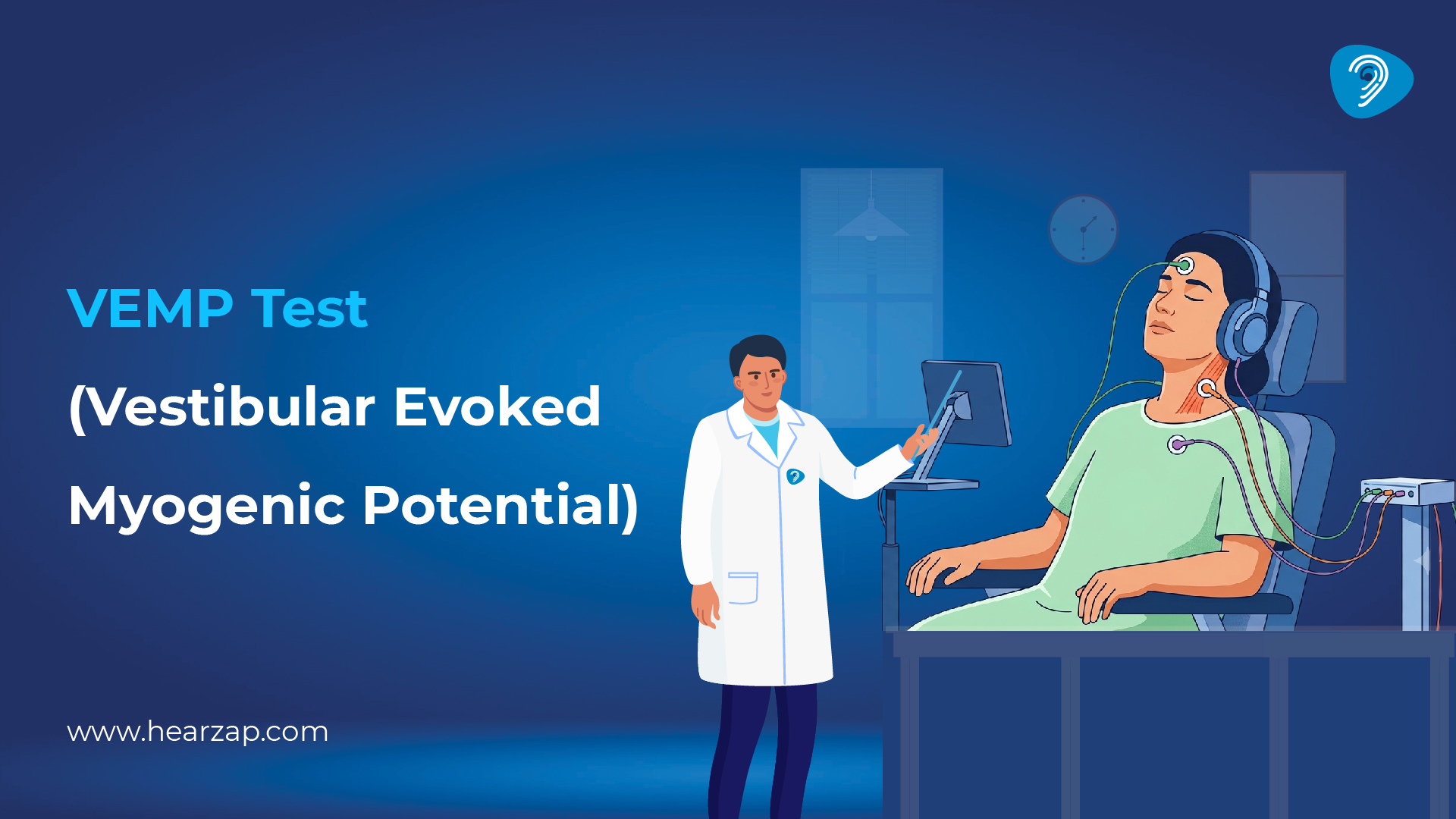
Persistent dizziness is difficult to trace. Balance draws on the inner ear, the brain, the eyes and the muscles all at once, so a fault in any one of them can produce much the same symptoms. A VEMP test looks at a part of the inner ear that routine hearing evaluations and many balance tests leave unexamined. This guide sets out what the assessment measures, how it is carried out and what its results can tell a clinician.
The Vestibular System and Its Function
Next to the cochlea, which handles hearing, the inner ear houses the vestibular system. Its semicircular canals register rotational movement of the head. Two small structures, the saccule and the utricle, register straight-line movement and the pull of gravity. Together these otolith organs tell the body whether it is upright, tilting or speeding up.
When one of these structures, or the nerve that serves it, is disturbed, a person may experience vertigo, nausea or unsteadiness. Some feel as though the ground is moving beneath them. Most standard balance tests concentrate on the semicircular canals, which leaves the otolith organs largely unexamined. This is where VEMP testing becomes particularly valuable.
Vestibular Evoked Myogenic Potentials Explained
Vestibular evoked myogenic potentials are tiny electrical signals produced by certain muscles when the otolith organs are stimulated by sound or vibration. In practice, vestibular evoked myogenic potentials VEMP testing shows how well the saccule, utricle and their nerve pathways are working. It is sometimes called a vemp ear test, although the muscles that are recorded lie in the neck and beneath the eyes rather than in the ear itself.
Two forms are in routine use:
- Cervical VEMP (cVEMP): Recorded from the sternocleidomastoid muscle in the neck. It mainly reflects the saccule and the inferior vestibular nerve.
- Ocular VEMP (oVEMP): Recorded from the muscles just below the eyes. It mainly reflects the utricle and the superior vestibular nerve.
Neither recording provides a complete assessment on its own. Taken together, they give a fuller account of otolith function.
Indications for Testing
An audiologist or ENT specialist usually suggests the assessment when symptoms point towards the inner ear or its nerve pathways. Typical situations include:
- Vertigo that recurs or has no clear explanation
- Dizziness triggered by loud sounds or pressure changes
- Lingering imbalance after a vertigo episode has passed
- Hearing that fluctuates alongside dizziness
- Earlier tests that failed to not identify the underlying cause.
What Does VEMP Test Diagnose?
One of the most common questions individuals ask is what a VEMP test can diagnose. The answer is that the assessment does not identify one disease. It shows whether the otolith organs and their nerves respond normally, and certain abnormal patterns lend support to particular diagnoses:
- Superior semicircular canal dehiscence: Where the bone over the canal is thin or missing, responses appear at unusually low sound levels. VEMP is among the most informative tests for this condition.
- Vestibular neuritis: Inflammation of the vestibular nerve can weaken or abolish the response, depending on which branch is affected.
- Meniere's disease: The saccule may be altered, which changes the recording.
- Vestibular migraine and central causes: Some people with vestibular migraine may show abnormal VEMP responses, although findings are variable and should be interpreted alongside clinical symptoms.
- Acoustic neuroma: Pressure on the vestibular nerve may reduce or remove the response.
Clinicians always interpret these findings alongside the patient's history and other test results. On its own, a VEMP recording guides the diagnosis but does not make it.
VEMP Test for Meniere's Disease
Meniere's disease brings episodes of vertigo, fluctuating hearing loss, tinnitus and a sense of fullness in the ear. It is associated with an excess of fluid in the inner ear, and the saccule is commonly affected in Meniere's disease. A vemp test for meniere's may therefore show smaller responses, absent responses or a change in the sound frequency to which the ear responds best.
Such findings can support the diagnosis and help follow the condition over time. They cannot establish it alone, because Meniere's is identified mainly from symptoms and hearing test results.
The VEMP Test Procedure
The VEMP recording itself usually takes around 20–30 minutes, while the complete appointment, including preparation and electrode placement, typically takes 30–60 minutes. It proceeds in the following order:
- Skin preparation: Small patches of skin on the neck, forehead or below the eyes are cleaned so the electrodes stick well.
- Electrode placement: Adhesive electrodes are fixed over the relevant muscles and on the forehead.
- Positioning: For the cervical recording, the patient sits and turns or lifts the head slightly to tense the neck muscle. For the ocular recording, the patient looks upward at a fixed point.
- Stimulation: Loud clicks or short tones are played through insert earphones, or a small vibrating device rests on the forehead.
- Recording: The equipment captures the muscle response, and many repetitions are averaged into one clear waveform.
Each ear is tested on its own. If a recording appears inconsistent, the audiologist may repeat the recording to confirm it.
Preparation and Possible Side Effects
Preparation is minimal. Individuals can eat and drink as usual, and comfortable clothing helps. Heavy makeup around the neck or eyes is best avoided. Anyone with neck pain, a spinal problem or an ear infection should tell the clinician beforehand.
As for vemp test side effects, the procedure is regarded as safe. Some individuals may find the sounds uncomfortably loud, and a few feel their neck tire from holding the required position. The adhesive on the electrodes can leave mild redness on the skin. Serious complications are not expected, and where a neck condition exists, the audiologist can adjust the positioning.
VEMP Test Interpretation
Interpretation centres on four features of the recorded waveform:
- Latency: How long the response takes to appear after the stimulus. A delay may indicate a problem along the nerve pathway.
- Amplitude: The size of the response. A small one suggests weakened otolith function, whereas an unusually large one can point to canal dehiscence.
- Threshold: The quietest sound that still produces a response. A very low threshold is a hallmark of superior canal dehiscence.
- Asymmetry ratio: The difference in response size between the two ears. A marked gap suggests one side is working less effectively.
Equipment, stimulus type and technique all influence the numbers, so each clinic works from its own reference values. A trained audiologist or otolaryngologist should therefore interpret the results.
VEMP Test Normal Range
No single figure defines the vemp test normal range. In cervical recordings, the first positive and negative waves tend to appear at roughly 13 and 23 milliseconds, although laboratories differ. Ocular recordings show their waves at other latencies, generally earlier. Amplitude shifts with age, muscle tension and stimulus strength, and responses often grow smaller in older adults.
A result outside the expected range does not mean disease is present. Clinicians weigh it against the patient's age, symptoms and other findings before drawing any conclusion.
VEMP Test Price and Cost
Many individuals ask about the vemp test price before booking. The vemp test cost depends on the city, the type of facility and whether cervical recordings, ocular recordings or both are performed. It is frequently billed as part of a wider vestibular assessment that includes hearing evaluation and other balance tests. In India, fees generally run to a few thousand rupees.It is advisable to confirm the cost and what is included with the diagnostic centre beforehand. Some insurance policies cover the assessment when a doctor has recommended it.
Limitations of the Assessment
VEMP has its limits. Fluid behind the eardrum or another middle ear problem can dampen or remove the cervical response even when the inner ear is healthy. Inconsistent muscle tension during recording can also make the results less reliable. For these reasons, the assessment works best as one part of a full evaluation and not as a stand-alone answer.
Conclusion
Balance disorders of the inner ear are hard to pin down, and the otolith organs are among the hardest structures to assess. VEMP offers a safe, non-invasive way to examine them. It helps identify conditions such as superior canal dehiscence, vestibular neuritis and Meniere's disease, and it supports sound treatment planning. Anyone with lasting dizziness or unexplained imbalance should begin by consulting an audiologist or ENT specialist, who can advise whether a VEMP test belongs in the evaluation.
FAQ’s
1. What does a VEMP test diagnose?
A) VEMP test helps diagnose balance disorders and problems affecting the inner ear and vestibular nerve.
2. What is a VEMP test?
A) A VEMP (Vestibular Evoked Myogenic Potential) test evaluates how the balance organs of the inner ear respond to sound or vibration.
3. How long does a VEMP test take?
A) A VEMP test usually takes about 20–30 minutes, while the complete appointment may last 30–60 minutes.
4. How do they do a VEMP test?
A) Small sensors are placed on your neck or around your eyes while you listen to sounds through headphones to measure your muscle responses.

Sri Sai Koti Chennupati
Head of Learning and Development
With a Master's qualification in Audiology and Speech-Language Pathology and more than 18 years of clinical practice, I am devoted to providing the highest standard of diagnostic and rehabilitative care in hearing and communication health.
Related Blogs
Online Hearing Test vs Audiologist Test: Which Is Better?
Contact us
We are here for all your hearing needs, from hearing tests to hearing aids. Fill out the form below, and we will give you a call soon.
Recent Blogs
By None | Sept. 16, 2026
By None | Sept. 9, 2026
By None | Sept. 7, 2026
By None | Sept. 5, 2026
By None | Sept. 4, 2026